Emily Tan
Oct 24, 2012

Asia tops first global social engagement index, China, Indonesia and India lead

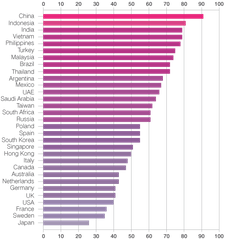
GLOBAL - China's high income (top 25 per cent) group in China lead the world in social engagement, followed by Indonesia and India, while the least socially active are 55 to 64- year-olds in Japan, according to GlobalWebIndex's Social Engagement Benchmark report.

Emerging nations lead in social engagement

GlobalWebIndex is an ongoing global study into the internet consumer's attitudes. Launched in July 2009, it has since delivered seven waves of research covering more than 152,000 internet users in 31 countries.

The league table has been calculated using GlobalWebIndex data from 31 countries detailing how much consumers participate in social media, whether they create or upload content and whether they engage with brands via these platforms either to review products, like a brand or upload content to brand sites.

To count towards the Social Engagement Benchmark rankings, consumers have to have carried out each task in the last month. Each key area—participation, creation and brand involvement—is scored out of 400 and the marks are added together and then converted to a percentage of the maximum 1200 score, which is then weighted to 100 point measure. The Benchmark is platform neutral and measures total active use of social media rather than usage of specific global, regional or local platforms such as Facebook, Twitter or weibo. 

The report found that consumers in fast-growing economies are more likely to use a social network or a microblog, upload a photo or video or review a product or brand than consumers in more mature markets.

In emerging markets where millions of people are coming online every year, social media is a natural part of the internet experience. Despite significantly lower internet penetration in markets like India, Brazil and Russia all have larger numbers of socially engaged consumers than Germany, the UK or Japan.
 
Other countries lagging behind Asian social powerhouses are the US, Sweden, France and the UK which are viewed as mature markets that are technologically advanced. The report reasoned that this is because online activity in these markets was developed before social became mainstream and is therefore less integrated into everyday use. 
 
While specific demographic groups may exhibit a higher or lower engagement rates than the market as a whole, market differences are consistent regardless of age, said the report. 
 
“What this report reveals is that we need to rethink how we classify countries when it comes to social media," commented Tom Smith, founder of GlobalWebIndex. "Thanks to this high engagement, social media reaches more of the total population [in emerging markets]. There is a huge opportunity for brands to connect via these channels but it’s not always in the markets where they think it is." 
 
Updated to include top 10 lists:
 
Top 10 most engaged markets:
  1. China
  2. Indonesia
  3. India
  4. Vietnam
  5. The Philippines
  6. Turkey
  7. Malaysia 
  8. Brazil
  9. Thailand
  10. Argentina
Top 10 least engaged markets
  1. Japan
  2. Sweden
  3. France
  4. USA
  5. UK
  6. Germany
  7. Netherlands
  8. Australia
  9. Canada
  10. Italy

Click for full view
 
Source:
Campaign Asia

Follow us

Top news, insights and analysis every weekday

Sign up for Campaign Bulletins

Related Articles

Just Published

Jan 29, 2026

Gemini 3 becomes the default model for AI Overviews

A pair of updates from Google see the tech giant attempt to gain a further foothold in the battle for AI-powered search supremacy.

Jan 29, 2026

Google criticised after blocking measurement ...

YouTube owner sent a 'cease and desist' letter to Barb and Kantar Media.

Jan 29, 2026

Inside Campaign Connect Indonesia: what matters to ...

Candid conversations on growth, AI and the cultural trade-offs of scaling brands, with more than 100 marketers in the room.

Jan 29, 2026

Meta hits $200 billion revenue milestone on ...

Meta reports double‑digit year-on-year revenue growth, with advertising once again accounting for almost all of the top line.